.png)


Promoted to Associate Professor with Tenure at Tel Aviv University!


I’m thrilled and deeply honored to share that I have been promoted to Associate Professor with tenure at Tel Aviv University.
This milestone marks a meaningful moment in my academic and personal journey. One that reflects years of hard work, a commitment to impactful science, and the trust of a community I value immensely. I am filled with gratitude and a profound sense of responsibility as I take this next step.
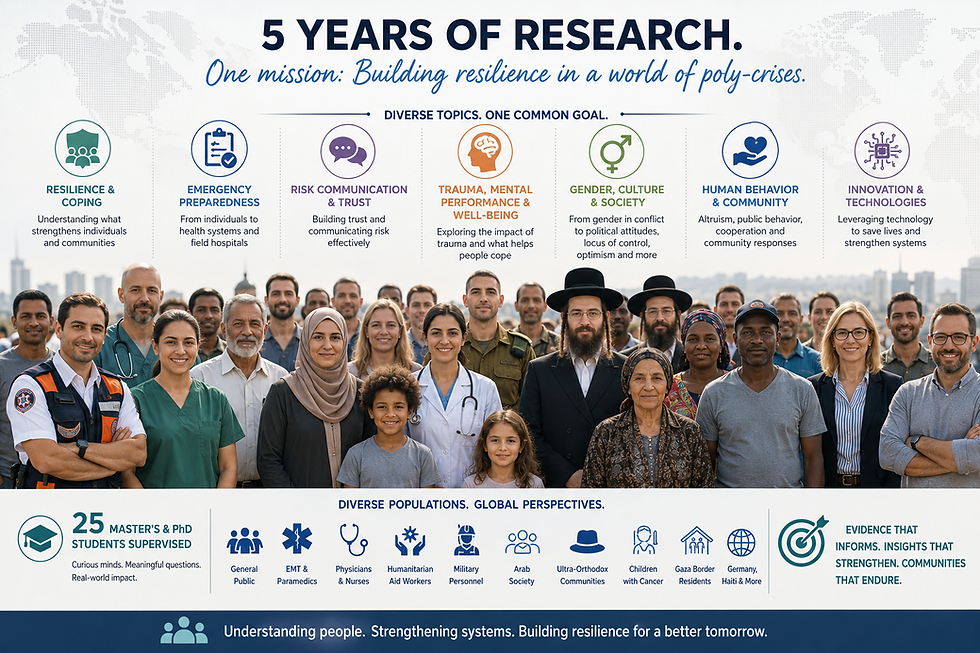
Over the past decade, my research has explored the intersection of disaster psychology, public health, and emergency management. My work has spanned topics such as:
Risk and crisis communication and its behavioral effects,
Public preparedness and self-efficacy during mass emergencies,
Civil resilience and adaptive community-based solutions,
Operational and clinical challenges in emergency medicine,
Vulnerable population preparedness and psychological barriers,
Death-related cognition, end-of-life decisions, and death anxiety.
None of this would have been possible without my dedicated students, whose curiosity, independence, and passion continuously inspire me. Their work has been published in leading journals, presented at international conferences, and recognized by both academic and professional communities.
Looking ahead, my research agenda will expand in several exciting directions:
🔬 Social Psychology and Sociology in Emergencies: Continuing my work with Terror Management Theory, I aim to deepen our understanding of how messaging, fear, gender, culture, and societal norms shape emergency behavior — particularly within underrepresented populations in Israel and abroad.
📊 Decision-Making and Emergency Modeling: In collaboration with colleagues in engineering, I plan to develop models for optimizing emergency resource allocation and cost-benefit frameworks to support policy-making under uncertainty.
🚑 Emergency and Disaster Medicine: Leveraging national trauma registry data and working with enthusiastic students, I hope to explore the long-term effects of trauma interventions and disaster medicine in varied contexts.
🌍 Global Collaborations: Building on successful projects like ENGAGE and TEAMS, I intend to lead multi-country studies on death avoidance and emergency preparedness, and develop international research on climate-related emergency readiness.
None of this would be possible without the steadfast support and mentorship of extraordinary individuals:
✨ Prof. Karen B. Avraham, Dean of the Gray Faculty of Medical & Health Sciences — thank you for your leadership and confidence in my work. ✨ Prof. Liat Lerner, Head of the School of Public Health — thank you for your trust and support throughout this process. ✨ Prof. Kobi Peleg and Prof. Shulamith Kreitler — my PhD supervisors, whose guidance shaped the scientist I am today. ✨ And my heartfelt thanks to Prof. Bruria Adini, whose mentorship and visionary leadership of our department have been an anchor and a guiding light in recent years.
To my colleagues, collaborators, students, and friends — thank you for believing in me.
More than anything, this promotion deepens my commitment to the values that drive my research: equity, resilience, human dignity, and evidence-based action in times of crisis. I look forward to the next chapter, and to continuing this journey together.
With utmost gratitude, Moran Bodas, MPH, PhD Associate Professor Department of Emergency and Disaster Management, School of Public Health, Gray Faculty of Medical & Health Sciences, Tel Aviv University


My first thought about helping students organise their own learning is that the everyday experience deserves as much attention as the larger explanation. Keeping track of unfinished tasks can make a busy school week feel more manageable. That connection helps me see why student learning organisation can be worth a closer look. I would be interested in a simple example, because it is often the ordinary details that make an idea memorable. What kind of planning system is simple enough for students to use consistently?
When it comes to introducing music through listening and practice, I would rather understand one useful detail properly than rush through a long list of ideas. Listening for one musical detail can make a short piece feel entirely different. That connection helps me see why music listening education can be worth a closer look. A short discussion of an everyday example would make this easier for me to connect with, especially as someone still learning about the subject. Which listening exercises work well before a learner starts studying notation?
What interests me about exploring stories through creative reading is how a broad idea becomes part of an ordinary day. A character's journey can become a starting point for imagining a different place or perspective. I would use that point as a starting question when considering creative reading activities. The part I would like to explore further is what happens when the idea meets a real situation with its own limitations. How would you encourage readers to connect a story with their own questions?
The topic of learning from subject specialists gives me a few things to think about, especially when the discussion moves beyond general advice. A specialist's example can show how a broad principle applies to a particular problem. That is the kind of detail I would keep in mind while exploring expert learning guidance. The part I would like to explore further is what happens when the idea meets a real situation with its own limitations. What makes an expert explanation useful to someone with little background knowledge?
Thinking about exploring the relationship between nature and wellbeing, I find the smaller practical questions more interesting than a quick conclusion. Noticing a familiar outdoor place can offer a simple starting point for thinking about our surroundings. It also gives the phrase ecopsychology and wellbeing a clearer meaning than a label on its own. I would probably come back to this question after trying to work through one concrete example rather than deciding immediately. How could a nature activity leave space for different personal responses?