.png)


Five Years, 25 Graduate Students, Countless Questions Answered

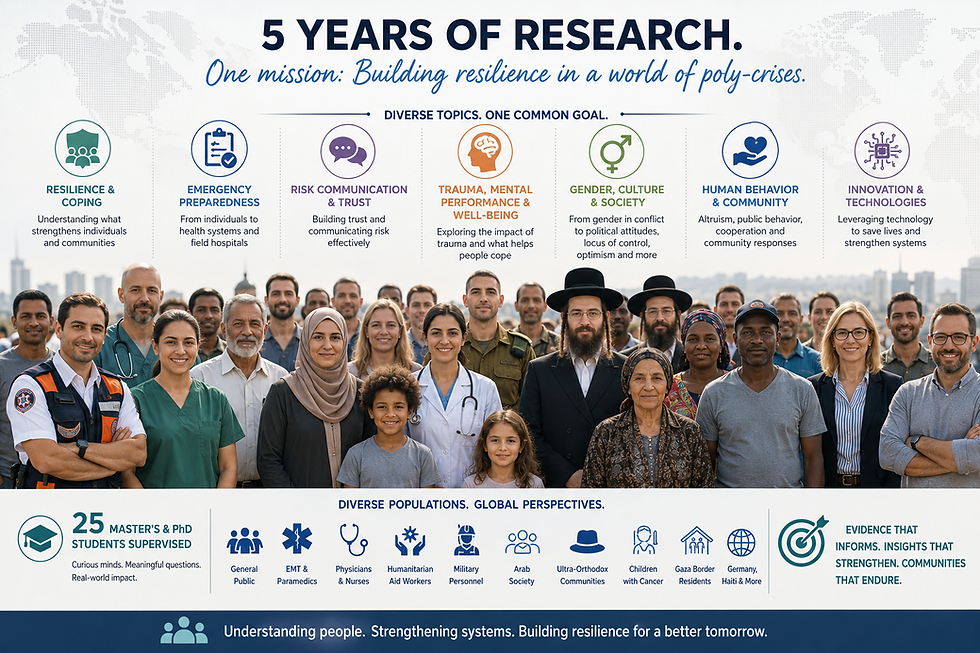
At first glance, our lab's research seems to cover completely different topics: resilience, trust, trauma, emergency preparedness, political attitudes, humanitarian workers, hospital staff, children with cancer, military personnel, technologies in emergencies, and much more.
But over the past five years, I've come to realize they're all part of the same story.
In early October, I will mark five years since joining Tel Aviv University. Looking back already, I'm especially proud of the remarkable body of research that has emerged through our lab.
🎓 Over these five years, I have had the privilege of supervising 25 Master's and PhD students. Together, we have explored how individuals, communities, organizations, and societies prepare for, respond to, and recover from crises.
🔬 Our work has examined resilience, emergency preparedness, trust, risk communication, public behavior during emergencies, health systems and field hospital preparedness, coping strategies, intergenerational trauma, gender in conflict settings, toxic masculinity, trauma and cognitive performance, fear of death, locus of control, political attitudes, altruism, optimism, emerging technologies in emergencies, and many other topics.
🌍 Our studies have spanned equally diverse populations: the general public in Israel, Emergency Medical Teams, EMTs and paramedics, physicians and nurses, humanitarian aid workers, military personnel, children with cancer, residents of Israel's Gaza border communities, Arab society, ultra-Orthodox communities, and populations in Germany, Haiti, and beyond.
Our ambition has never been to study crises for their own sake, but to generate evidence that helps decision-makers, practitioners, health systems, and communities become better prepared for the next one.
Taken together, these projects have reinforced something I believe deeply: resilience is not a single construct, nor can preparedness be understood from a single disciplinary lens. As societies face increasingly interconnected crises, we need frameworks that bring together psychology, sociology, public health, emergency management, and organizational science to better understand—and strengthen—human resilience.
🙏 Above all, I am grateful to the 25 Master's and PhD students who have driven this work. Every thesis challenged assumptions, expanded my own thinking, and reminded me that the best research is always a collaborative journey. Whatever this lab has accomplished over the past five years is first and foremost a reflection of their curiosity, dedication, and perseverance.
If these five years have taught me anything, it is that preparing for the poly-crises of the future requires more than better technologies or better policies. It requires a deeper understanding of people—their fears, motivations, relationships, decisions, and remarkable capacity to adapt.
I look forward to continuing that journey together.


Comments